Thursday, October 26, 2017

MULBERRY CULTIVATION (CONT...7) - MORICULTURE

Climate: Mulberry can be grown under various climatic conditions ranging from temperate tropical

Atmospheric temperature: An atmospheric temperature, ranging from 240C to 280C is found to be optimum for good growth of mulberry. Growth and sprouting of buds cannot be obtained at temperatures below 130C and above 380C.

Rainfall: Mulberry can be grown in places with a rainfall range of about 600 mm to 2 500 mm. under low rainfall conditions, the growth is limited due to moisture shortage resulting in low yields. More than the total precipitation, rainfall distribution is important. On an average 50 mm once in ten days is considered ideal for mulberry.

Atmospheric humidity: Humidity range of 65 to 80 percent is considered ideal for its growth. Under rained conditions, due to higher moisture in soil and high atmospheric humidity, the quality of leaf produced during the rainy season is better than the leaf produced during other seasons.

Sunshine: Sunshine is also one of the factors controlling the growth of mulberry. In the Temperate countries, mulberry grows with a sunshine range of 5.0 to 10.2 hours a day while in the tropics; it grows well with a sunshine range of 9.0 to 13.0 hours a day.

Elevation: Mulberry cultivation is practiced at altitudes from 22 m to 1 735 m above MSL, while in the U.S.S.R., it is practiced 400 to 2000 m.

Soils: Soils of mulberry field have to maintain the mulberry plants for sustained maximum productivity of quality leaves. The soil should be deep, fertile, well drained, and clayey loam to loam in texture.

Planting:
Location and Topography:  Mulberry plantation should desirably be established close to the rearing house for quick transport and immediate use of the leaves for feeding.
Environmental factors: Growth of mulberry and the quality of its leaves are often affected by various environmental factors; the neighboring woods, buildings, factories, tobacco fields, orchards etc., greatly influence the quality of the leaves produced.

Preparation of land: After selection of land for mulberry cultivation, it is necessary to prepare the land in the proper manner. The field is to be leveled and the fertility level improved

Planting season: For proper establishment of mulberry plantations, early spring and late autumn seasons are best suited. Planting in winter and summer seasons are to be avoided.

Direction of planting: In temperate regions the direction of the rows of planting is important. Depending upon the light intensity (sunshine hours) and wind direction mulberry seedlings are to be planted in rows either in north south or east‑west directions, making the rows parallel to the direction of wind.

Planting distance: The planting distance depends upon the agro‑climatic conditions (sunshine, precipitation, temperature, etc.) soil fertility level, intensity of cultivation practices adopted including the training and harvesting methods and also the variety of mulberry planted.

Planting material: There are various methods of propagating mulberry plants. Generally, plant is raised either from the seed or through vegetative propagation from stem cuttings or layering and grafts.

Removal of the planting material from the nursery: Saplings are raised in the nursery well ah of planting. Well grown one to two year old saplings are removed from the nursery, care being taken not to damage the roots or the main stem.

Planting method: After preparation of land, pits of a standard size of 40 cm width, 40to 50 cm depth are made. Where inter plant distance is over 1.2 m, trenches of 45cm x 45 cm are opened in the planting row.

Inter cultivation: The main object of inter cultivation is to remove the weeds and loosen the soil so as to allow the rain water to soak deep into the soil and for better aeration and nitrification.

Mulching: Mulching is covering the soil in between the row space with some protec­tive material. It helps in conserving moisture, keeps the soil loose and friable, protects the plants from winter injury, and keeps down the weeds.

MULBERRY CULTIVATION (CONT...8) - IRRIGATION

Mulberry leaf production is often limited by the amount of available soil moisture and it can be substantially increased by supplemental irrigation. Since deficiencies of pre­ capitation often occur in the major mulberry growing tracts of the world, it is necessary to provide supplemental irrigation to maintain optimum soil moisture conditions

Irrigation in relation to soil: For efficient use of irrigation water, just enough water is to be applied to bring the moisture content of the soil in the root zone to its field capacity.

Appearance of mulberry crop: Mulberry plants with abundant supply of water are characterized by luxuriant growth, the foliage well developed and the leaves succulent and shiny.

Frequency of irrigation: Frequency of irrigation for the mulberry crop depends upon several factors such as growth phase of plant, soil type and other agro‑climatic conditions.

Quantity of water irrigated: The important considerations for the quantity of water to be irrigated is the root distribution pattern of plant, the climatic conditions and soil type. In order to provide effective irrigation, the following methods of soil moisture measurements are followed.
1.      Gravimetric method of determination of soil moisture;
2.      Using electronic properties of porous blocks;
3.      Use of Tensiometers;
4.      Neutron method of measuring soil moisture.

Interval between irrigation: When the mulberry plant is in the active growth phase, i.e. the sprouting and foliar developmental stages, the crop has to be irrigated frequently and plant growth takes place all the year round.

Quality of water: In addition to the quantity of water, quality of irrigation is also equally important. Normally irrigation water for mulberry should contain less than 1 000 PPM of total soluble salts.

Methods of irrigation: Of the different methods of irrigation adopted, the furrow, flat bed and basin methods are normally practiced.

Furrow method: In the furrow method the field is laid out into a series of ridges and furrows.

Flat bed method: The field is divided into rectangular beds with bunds all around and channels on the sides.

Basin method: The basin method is suitable mostly for tree plantations. In this system irrigation water from the supply source is lead into the basin around the trunk.

Overhead or sprinkler method: This method of irrigation can be practiced in undulating lands where low and high bushes are cultivated. The advantages are (i) most efficient in economizing water use; (ii) there is uniform distribution of water on the foliage; (iii) the percolation loss in porous and sandy soils is avoided; (iv) this is most suited for emergency irrigation; and (v) it can be followed with advantage on sloppy and shallow lands.

Influence on the leaf yield: Yield of mulberry leaves is strongly influenced by both quantity and quality of irrigation water. The increase in leaf yield due to irrigation when compared with rain fed cultivation. Added to this, the leaf production is increased three to four times when balanced fertilizers are applied at regular intervals in addition to irrigation.

Influence on quality of leaf:  The nutritive value of the leaves is determined by chemical estimation and feed values and as judged by the rearing performances, leaves obtained from irrigated mulberry possess more moisture and protein and are more nutritious than those from rain fed crops.

Provision for drainage: Provision of adequate drainage improves soil structure and its productivity. Under waterlogged conditions, the mulberry plants wilt under severe oxygen tension resulting in poor root respiration.

MULBERRY CULTIVATION (CONT...9) - MANURING

The importance of application of fertilizers and manures for both increased produc­tivity and improved quality and quantity of mulberry leaves has been well recognized. It is fully realized that for any increase in leaf yield of mulberry per unit area of land, the native soil fertility alone cannot be relied upon and recourse has to be made to the application of fertilizers and manures. Of the three major elements, viz. nitrogen, phosphorus and potassium, nitrogen is the most important and vital for increased production of good quality leaves.

Organic Manures: The common organic manures used for mulberry are farmyard manure and compost.

Influence of Fertilizers on Mulberry growth: Nitrogen is a constituent of protein and therefore a constituent of every living cell.

Nitrogenous fertilizers: Four major forms of nitrogenous substances used as manures and fertilizers must be recognized and they are: the water soluble proteins and other organics, the water insoluble organic non‑protein substances, the nitrates, and the amoniacals.

Phosphoric fertilizers: The two types of phosphoric fertilizers recognized are water soluble forms and cit‑r‑ate soluble forms.

Potassic fertilizers: The chief commercial potassic fertilizers are sulphate and chloride forms. For mulberry potassium sulphate and potassium chloride are generally used.

Balanced use of fertilizers: Instead of applying each nutrient separately, compound fertilizers containing NPK and also minor nutrients in small quantities are being recommended.

Influence of fertilizers on the quality of leaves:Among the nutrients in fertilizers, nitrogen has the greatest influence on the quality of mulberry leaves.

Influence on the leaf yield: Among the three major nutrients, nitrogen has a profound influence on the total yield of mulberry leaves.

Dosage of fertilizers and manures: Quantity of manures and fertilizers depends upon the soil type, removal of plantation, rainfall distribution pattern, spacing, pruning and harvesting methods and also seasonal conditions.

Time of application of fertilizers:
In temperate climates like in Japan and Russia, bulky organic manures which decompose and release nitrogen slowly, are applied during the winter, when the mulberry plants are in dormant stage.

Method of application: The two general methods of applying manures and fertilizers are broadcasting over the surface of the field and mixing it with the soil or localized placement.

Importance of liming: The main purposes of applying lime to soil are to neutralize soil acidity and to improve the physical properties of the soil.

Reclaiming alkaline soils: Gypsum is applied in alkaline and saline soils as soil amelioration. The quantity of gypsum required per hectare of such soil is estimated on the pH level and the sodium salts present.


Micronutrients: In addition to the essential nutrients mentioned above, micronutrients like magnesium, boron, iron, manganese, copper, zinc and Sulphur are also essential. Since these micronutrients are required in small quantities, the soil itself provides them to the plant.

MULBERRY CULTIVATION (CONT...10) - PRUNING

Principles of pruning: Pruning is the methodical removal of certain branches of a mulberry plant with the object of giving the trees a convenient shape and size, to increase the leaf yield and to improve its feeding value. Pruning is essential to improve the yield in certain agricultural and horticultural plants.

Cut forms: In order to get a guaranteed leaf harvest, every year, it is desirable to make a certain form or shape of a plant and maintain this plant form.

Training: Low cut form and pruning: At the time of planting, the seedlings are cut to a height of a 15 cm above the ground level

Types of pruning: The medium cut forms include the fist form, non‑fist form and various other forms of pruning.

Fist form: The branches are cut at the base, maintaining a constant height. Fist style pruning promotes growth of latent buds, besides normal buds, thus making the plant grow into a small tree. By this method pest and disease control becomes easy.

Non‑fist form: Branches are cut leaving basal parts to some extent and in this style the trees become taller every year.

MULBERRY CULTIVATION (CONT...12) - DISEASES AND INSECT PESTS

Diseases:  There are different kinds of diseases of mulberry which are caused by fungi, bacteria, viruses and also mineral deficiencies or physiological disorders. Of these ten or twelve diseases cause much damage to mulberry plants.

White root rot: White root rot is caused by the pathogen Rosellinia necatrix, Berlesse, belongingto the class Ascomycetes. The diseased mulberry plants become weak, the leaf buds grow feebly, the leaves wither off and soon the plant dies.

Violet root rot: This is caused by the fungus Helicobasidium mompa, Tanaka, belonging to the class Basidiomycetes. The chief symptoms of the disease are, sudden withering of leaves and collapse of plants during rainy season.

Controls of root rot diseases: As soon as the symptoms appear, the diseased plants should be uprooted. A meter deep pit is dug around the diseased plants and the soil excavated should be piled up in an isolated place to prevent the spread of the diseases.

Mulberry trunk rot: This disease is caused by Polyporus hispidus (Bull) Fr. belongs to the class Basidiomycetes. The affected trees show symptoms such as drying up of branches and rotting of branches and trunk, terminating in the death of the tree.

Leaf spot diseases: Several leaf spot diseases are reported on mulberry. They are caused by Cercospora moricola Cooke, Septogloeum mori Briosi and Cav.

Prevention and control: Spraying suitable fungicides (e.g. Difolatan 0.2 percent) on the Toungleaves (soon after picking or pruning, i.e. before the onset of the incidence) pre­ vents the infection. The sprayed leaves should be fed to silkworms only after a certain period of time to avoid toxicity.

Powdery Mildew: This is caused by the pathogen Phyllactinia corylea (Pets) Karst, belonging to the class Ascomycetes. The disease is common in all temperate regions.

Prevention and control: Dusting fine Sulphur or spraying dithane, Sulphur suspension or lime Sulphur mixture on the back of the leaves may be effective.

Mulberry Rust: It is caused by the pathogen Aecidium mori (Barcl) Syd. et. Butler, belonging to the class Basidiomycetes. The pathogen infects the leaves and green woody portions of the plant.

Prevention and control: Spraying Sulphur suspension or lime sulphur mixture in appropriate concentration on the plants is effective in controlling the disease

Dogare blight: Dogare blight is caused by Diaporthe nomurai, Hara.

Prevention: Selection of resistant mulberry, high cut pruning, and cutting and burning of the infected plants are recommended to prevent the disease.

Twig blight: This is also called "Megare" disease and is caused by the pathogen Gibberelle‑mo‑ricola (De Not) Sacc.

Prevention and control: Removal of infected twigs and spraying the plants with suitable fungicides recommended for checking the Dog are blight disease are effective in preventing megare blight also.

Shownia disease: The leaves develop rusty brown patches, showing deficiency of potash, proteins and sugar contents. The exact cause of the disease is not established. This disease is common in some parts of West Bengal in India. The diseased leaves are poisonous to the silkworms and may cause flacherie. Heavy rains may favor the onset of this disease. Potash manuring may prevent the incidence.

Bacterial diseases: Three different pathogenic bacteria cause diseases in mulberry:

Bacterium moricolum, Yendo et. Higuchi: This short rod shaped, non motile, gram positive bacterium erodes the base of the twigs and forms a whitish colony around.

Diseases caused by viruses: Mulberry plants are affected by some viruses and mycoplasma of which two are common.

Dwarf disease: This disease is caused by mycoplasma. The disease is transmitted by insect vectors such as leaf hoppers, Hishimon‑yokobai (Hishimonus sellatus uhler) and Hishimon‑modoki (Hishimonoides). Due to this disease, the leaves become yellow, and disorderly arranged.

Mosaic disease: This disease causes wrinkling of the ventral surface of the leaves together with chlorotic conditions. The leaves become distorted and twined.

Prevention and control: The following steps are recommended for controlling the virus diseases:
(1) Growing resistant varieties.
(2) Selection of saplings and cuttings from disease free plants and growing them in disease free plots.
(3) Proper cultural practices.
(4) Eradication of insect vectors by spraying suitable insecticides.

Deficiency diseases of mulberry: Apart form diseases caused by various pathogenic agents, mulberry plants show symptoms of many deficiencies in minerals. The following are some of the common deficiency diseases noticed in mulberry.

Nitrogen deficiency: This causes a slow, weak growth of plant with less branching and chlorosis of leaves. The young green leaves show mottling and chloritic spots.

Potassium deficiency: The deficient plants show marginal scorching (drying) of leaves and later the leaves become course, non‑juicy and necrotic.

Phosphorus deficiency: This becomes apparent in the plants as intra‑veinal chlorosis of older leaves. The chlorosis spreads throughout the leaf and this is followed by marginal necrosis and defoliation.

Magnesium deficiency: Magnesium deficiency causes chlorosis of older leaves and necrotic spots on the leaves. The leaf tips and margin become dried and scorched.

Calcium deficiency: Calcium deficiency causes deformation of young leaves, with necrosis along the veins and makes the leaves pale.

Sulphur deficiency: There will be slight chlorosis of the leaves with general lack of new growth. The stem becomes slender.

Insect Pests: Mulberry, like most of the economic plantations and field crops is often attacked by various insect pests.

Lepidopteran pests
Diacrisia obliqua WALKER: Belongs to the family Arctidae of Lepidoptera commonly known as "Bihar hairy caterpillar". It is a polypbagous pest and is responsible for the highest damage to mulberry plants.

Life cycle and habit
Egg: 1000 ‑ 1200 eggs green in color with a metallic shining color are laid by the female moth in small batches on the lower surface of the leaves. The incubation period is five to seven days.

Larva: The hatched larvae are dull white in color with prominent black head and the body covered with sinall hairs. They measure 0.2 cm in length.

Pupa: They pupate in loose soils. The pupa lies inside a thin silken cocoon formed by the interwoven shed hairs of the larva. It measures about 2 cm and is dark brown in color. The pupation lasts for 12‑14 days.

Imago: The moths are light brown in color. The abdomen is brick red with rows of black dots on lateral and mid dorsal sides. The wings have scattered black spots. The female moth with wing expanse of 4.5 cm measures 1.75 cm in length. They are nocturnal in habit.


Control measures: (i) Collection of egg masses in a mechanical way to reduce the number of successive generations. Early stage larvae can be identified by their gregarious habits and the dried leaf on which they feed can be collected and destroyed. (ii) Deep ploughing and flood irrigation is useful in killing the pupae which pupate in soil. (iii) Biological control: In nature, a Hymenopteran parasite, Apanteles obliqua, is found to parasite the larvae by laying the eggs on the body. The parasites puncture the host larva to come out for pupation, thus killing the host. (iv) Chemical control: 0.2 percent D.D.V.P. can be spread to kill the larvae and the sprayed leaves can be used for silkworm rearing after three days.

MULBERRY CULTIVATION (CONT...11) - HARVESTING OF LEAVES

The method of harvest of mulberry leaves depends on the rearing practice in vogue in the locality or nation. The leaves are fed as a whole or as bits and in some cases the entire shoot or branch is used for feeding the worms.

Leaf picking: In this method the leaves are picked individually from the plant. After the leaves are harvested from the main stem, the terminal bud is removed and the axillary buds on the main stem allowed developing.

Branch cutting: In this method the entire branch with leaves is cut and fed to the worms after the third molt.

Whole shoot harvest: The branches are cut close to the ground level and the top is fed to the worms settled for fourth molt. Thus topping helps uniform maturity of the leaf left over on the plant. The effect of top clipping is that the energy which would otherwise go to the formation of new leaves is redirected to the leaves left behind on the plant, making them more uniformly mature. The shoots are generally harvested at an interval of 10‑12 weeks, obtaining four to five harvests in a year. This method is suitable where the sprouting takes place all the year round.

Time of harvest: The quality of leaves is affected to some extent by the quickness in withering. Therefore the harvesting time in a day influences the length of time for which leaves can remain quality feed.


Preservation of leaves: The fresh mulberry leaves are more palatable and nutritious to the silkworms. 

REARING OF SILKWORM AND PRODUCTION OF COCOON

Rearing program
In sericulture areas which enjoy temperate or subtropical climates, silkworm rearing is carried out twice a year in the spring and the autumn or three times, in the spring, the summer and the autumn, coinciding with the growth and production of mulberry leaves. In tropical areas, however, where mulberry growth is continuous throughout the year silkworms are reared five to six times in a year. Whether rearing is conducted frequently or only two or three times a year it is always beneficial to have a planned program. It is advisable to rear a greater number of lying at a time than to rear much bathos at very short intervals. The program of silkworm rearing in a farm is determined by the following considerations:
1.  Conditions of mulberry growth and yield of mulberry leaf.
2.  Availability of labor for rearing silkworms.
3.  Facilities for rearing silkworms, i.e. suitable buildings and equipment.
                
Conditions of mulberry tree growth and yield of mulberry leaf: The time to rear silkworms is when there is a proper sprouting of mulberry leaves and a plentiful supply of good quality leaves. The yield and the quality of the leaf depend to a great extent on the agronomic practices followed for the cultivation of mulberry trios namely irrigation, application of fertilizers and proper activation.

Availability of labor: Since sericulture is a labor‑intensive rural industry requiring much labor the volume of rearing to be undertaken will also depend on the adequate availability of labor at a reasonable wage. If labor costs are high economic production costs will also increase.

Facilities for rearing silkworms: The facilities required for silkworm rearing are a rearing space or houses, and rearing equipment.

Rearing space or houses: Silkworm rearing demands certain specified environmental conditions particularly as regards temperature and humidity. Rearing houses are planned and constructed to provide and maintain proper environmental conditions to ensure good quality cocoons.

Equipment for silkworm rearing: The equipment required for a model rearing house for shelf rearing is as follows: in the model rearing house in each of the rooms 200 ‑ 250 layings or 800‑1000 layings in the entire rearing house can be reared under shelf rearing.
Rearing stands
Ant wells
Rearing trays
Rectangular wooden trays or boxes
Paraffin pape
Foam rubber strips
Chop sticks
Feathers
Chopping board
Chopping knives
Mats
Leaf chamber
Cleaning nets
Mountages
Hygrometers and thermometers
Feeding stands

Other equipment: Among the other items required are feeding basins, preferably plastic, to, hold chopped leaves, and buckets and basin stands, etc., A sprayer is also required for disinfecting the rearing room, for spraying water on to the leaf chambers, etc. Leaf baskets made of bamboo are used for carrying the leaves from the garden to the rearing rooms.

Sanitation and preparations for rearing silkworms: The silkworms must be reared with the utmost care since they are very susceptible to disease. Bacteria, moulds and some protozoan attack the silkworms readily and any disease, once it breaks out, spreads quickly. To prevent disease, good sanitation methods and hygienic rearing techniques must be meticulously followed.

Hatching, feeding, cleaning and spacing
Hatching: Hatching of silkworms generally starts early in the morning. The process of transferring the silkworms to rearing trays is called "brushing". A suitable time for brushing is about 10.00 as most of the larvae hatch by 08.00 and develop good appetites within two hours of hatching.

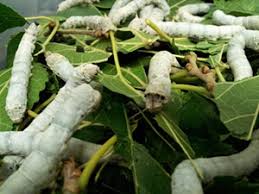
Feeding silkworms: Silkworms are fed to satisfy their appetites and to ensure their, healthy and uniform growth. It is therefore necessary to preserve the quality of leaf during feeding and to keep the rearing beds clean.

Bed cleaning: Removing the old mulberry leaves, faecal matter of silkworms, exuviae, any dead or unhealthy silkworms, etc., from the rearing bed is called bed cleaning. Accumulation of any such matter creates environmental conditions detrimental to the health of silkworms.

Spacing: Provision of adequate rearing seat space is of great importance for the vigorous and full growth of silkworms. As the worms grow in weight and size, the density in the rearing bed increases and conditions of overcrowding are faced.

Overcrowding of silkworms means insufficient space for the free movement and free feeding of the worms and so the larvae crawl over one another.


The spacing to be provided for different ages of silkworms of 50 layings or a box of 20 000 eggs are given below:
                                            At the beginning              At the end
                                              of each age                     of each age
                                                   (M2)                              (M2)
Univoltines and bivoltines species:
Age
lst                                                0.2                                  0.8
2nd                                              1.0                                  2.0
3rd                                               2.0                                  4.5
4th                                               5.0                                 10.0
5th                                             10.0                                 20.0

Multivoltines and bivoltines species in tropical areas:
Age
1st                                              0.2                                   0.5
2nd                                             0.5                                   1.5
3rd                                             1.5                                   3.0
4th                                             3.0                                   9.0
5th                                             9.0                                 18.0


Care at molting
Uniform growth of silkworms of any batch depends on the care given to rearing. Among the various steps involved in the rearing of silkworms the handling of silkworms during molt is of particular importance. Silkworms under proper rearing conditions would all settle uniformly for molt and also come out of molt uniformly.

Environmental conditions
Since silkworms have been domesticated for many centuries, they are by nature quite delicate and very sensitive to environmental conditions. In the commercial production of cocoon crops optimum environmental requirements ensuring maximum productivity of good quality cocoons of very high silk content are aimed at.

Temperature: Temperature plays a vital part in the growth of silkworms. Silkworms are cold, blooded animals and as such temperature will have a direct effect on the various physiological activities of their systems.

Since the temperature is in direct correlation to the growth of the silkworms’ excessive fluctuations in temperature are harmful and should be avoided. The optimum temperatures for rearing silkworms of different instars are as follows:
In stars                                                                                   0 C
     lst                                                                                  26 ‑ 28
   2nd                                                                                  26 ‑ 28
    3rd                                                                                 24 ‑ 26
    4th                                                                                 24 ‑ 25
    5th                                                                                 23 ‑ 24
Light: Silkworms are photosensitive and generally have a tendency to crawl towards dim light. They do not like either strong light or complete darkness. In complete darkness the larval period is shortened and in bright light there is a tendency towards production of heavy cocoons.

Leaf quality
The mulberry leaf is the exclusive food of the silkworm Bombyx mori. It is essential that the mulberry leaves axe not only in abundant supply but are also of good and suitable quality. Leaf quality has much to do with the success of silkworm rearing and the quality of the cocoons produced. Similarly in the case of fertilizer application, higher doses of nitrogen fertilizer induce more vigorous growth in mulberry trees and the leaves from such trees contain more water and protein.

Harvesting and storage of leaves: Leaves picked from mulberry plants lose water rapidly due to withering and as a result the leaf quality is considerably affected. Leaves that lose moisture beyond a certain level are no longer relished by the silkworms which do not feed adequately on such leaves with the result that they are not nourished properly.

Rearing early-age silkworms
Different methods of rearing the early ages are practiced. In all methods importance is given to maintenance of leaf quality and correct humidity and temperature in the rearing bed so that vigorous and healthy development is ensured. The two methods used at present are: 1. paraffin‑paper rearing and 2. box rearing.

Paraffin paper rearing: Paraffin paper is used as a bottom layer and as a cover for the rearing beds in the usual rearing trays. The object is to maintain the optimum humidity in the bed and to keep the leaves fresh for a longer period by preventing moisture loss through evaporation. Feeding is restricted to two or three times a day and so the labor required for feeding is reduced.

Box rearing: Boxes or trays made of wood or plastic or galvanized iron at least 10 ‑ 15 cm deep are used for box rearing. The boxes used may be with or without lids.

Rearing in boxes with lids: In this case a sheet of paraffin paper is spread over the bottom of the tray. The rearing bed is prepared over this and covered with another sheet of paraffin paper after putting in place the wet foam rubber pads.

Rearing in boxes without lids: Wooden boxes of uniform size and 10 ‑ 15 cm deep are used. Each box is provided with a sheet of paraffin paper for the base, over which the rearing bed is prepared, wet foam rubber pads axe placed on all the four sides and the bed is covered with another sheet of paraffin paper.

Co‑operative rearing of young silkworms: Silkworms not reared properly in their young ages are prone to disease at later stages, and crops may even fail. Maintenance of optimum temperature and humidity, supply of suitable leaves, and handling of the young‑age rearing with utmost care, etc., demand highly technical skills, which are not often available to the ordinary silkworm rearer.

Rearing late‑age silkworms
Late‑age worms in the fourth and fifth instars need comparatively less humid rearing conditions and also preferably a lower temperature. These are real feeding stages when the worms consume about 90 ‑ 95 percent of the total feed, and therefore, adequate spacing and an adequate amount of feed should be given to these two ages.

Methods of rearing late‑age worms: Three methods of rearing are commonly known: shelf rearing, floor rearing and shoot rearing.

Shelf rearing : Rearing of silkworms in rearing trays arranged one over the other in tiers on rearing stands is called shelf rearing.

Floor rearing: This is another method of rearing silkworms on fixed rearing seats. The rearing seats are arranged in two to three tiers so as to accommodate as many silkworms as possible.

Shoot rearing: Shoot rearing is very similar to floor rearing. Silkworms are reared on big branches in one or two tiers. The big shoots harvested from the fields are fed straight away to the worms.

Mounting and harvesting
Toward the close of the final larval instars the silkworm stops feeding and gets ready to build the cocoon prior to transforming itself into the pupa inside the cocoon. The feeding during the final instars may last from five to seven days in the case of multivoltines and bivoltines races in the tropical areas, and seven to nine days in the case of bivoltines and univoltines races in sub‑tropical areas. With the cessation of feeding and as the stomach contents empty, the fully mature larva becomes translucent and yellowish in appearance which is a clear indication that the worm is fully ripe and is ready to be mounted on to montages or cocooning frames. Such ripening larvae normally crawl towards the periphery of the rearing trays in search of suitable supports for building their cocoons. Thus the process involved in picking the ripe worms and putting them on to the suitable montages for the spinning of cocoons is called mounting of worms.

Collecting mature worms for mounting: Collecting mature silkworms and mounting them on the montages is a laborious job. Usually the mature larvae are picked by hand by skilled labor capable of identifying the mature worms, which are collected in trays and later put on the montages.

Method of free mounting: With this method instead of collecting the mature worms from the beds, the montages are placed in the beds themselves and the worms crawl up onto them.

Density of mounting: In the case of revolving montages density is automatically adjusted since only the number required to fill the empty blocks in the cocooning frames are mounted. Ordinarily a single frame contains about 156 blocks and 10 such frames are put together to form a unit of turning cocooning frames which can mount 1560 worms.

Environmental conditions required for mounting: Maintenance of the required environmental conditions during mounting is important as it determines the quality of the cocoons spun. Silkworms under mounting normally require a comparatively drier 0 atmosphere. Ideal conditions for good spinning are temperatures not exceeding 26 0 C and relative humidity between 60 and 70 percent. If temperatures rise above 26 C the quality of the cocoon is affected. It is particularly important that during the first 50 hours after mounting ideal conditions are maintained for cocoon spinning.


Harvesting of cocoons: After spinning the cocoon the larva undergoes metamorphosis inside the cocoon and becomes the pupa. Generally pupation takes place on the fourth or fifth day of spinning. The pupa when formed has a thin cuticular skin which is soft to the touch and ruptures easily if disturbed; therefore early harvesting of cocoons should be strictly avoided. In course of time the pupal skin hardens and turns dark brown and it is at this stage that cocoon can be harvested. The proper time for harvesting cocoons is on the seven or eighth day of spinning in the case of bivoltines and univoltines races, and on the fifth day in the case of multivoltines races. Harvesting must not be unduly delayed beyond the period mentioned above lest any parasitic insects infecting the silkworm larvae emerge from the pupa and damage the cocoons.